18 December 2004

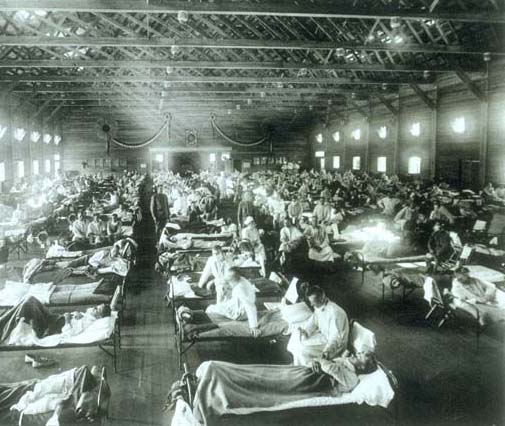
Emergency hospital during 1918 influenza epidemic, Camp Funston, Kansas (source: National Museum of Health and Medicine, AFIP).

A bout of the flu can be mild. In young, healthy adults, many infections pass unnoticed. But sometimes the influenza virus evolves into a strain that decimates its victims. The worst known strain swept the world in the Fall of 1918, infecting 500-1000 million and killing 40-100 million, about 2-5% of people.

There are several theories about where the pandemic began, but the likeliest origin was in Haskell County, Kansas, in the United States. People in the sparsely populated county, where farmers raised pigs, poultry, cattle, and grain, began suffering from influenza in late January 1918. Unusually for flu, it was young, healthy adults who were hardest hit. Victims fell ill suddenly, many progressing to pneumonia and dying, often within days. Within weeks, however, the epidemic ended. The natural geographic isolation of this community normally might have contained the fatal flu in a sort of unintentional quarantine, but the First World War intervened. Men were uprooted from their home towns and congregated in huge numbers in army camps for training and then shipping out to other camps or to fight in Europe. The destination for men from Haskell County was Camp Funston, part of Fort Riley, Kansas, where the first influenza case was reported in early March. As soldiers moved among camps, the virus spread. Within two months, the epidemic spread to most of the army camps and most of the largest cities in the United States. As American soldiers went to France, so did the virus, spreading first from the port of Brest.

The flu then spread worldwide. The pandemic reached its height in the Fall of 1918. Spain was affected early, and because Spain was not fighting in the World War, there was no wartime censorship, and news of the outbreak became widely known, leading to the flu being called the Spanish Flu in many countries. In Spain, however, it was called French Flu or the Naples Soldier. In India, about 12 million people died of flu. In some US cities, people died so quickly that morticians couldn’t cope with the bodies. According to Jessie Lee Brown Foveaux, who worked in the Fort Riley laundry during the epidemic: “They were piling them up in a warehouse until they could get coffins for them.”

The disease started with cough, then headache. Temperature, breathing and heart rate increased rapidly. In the worst cases, pneumonia came next, the lungs filling with liquid, drowning the patients and turning them blue from lack of air. Patients bled from every orifice: mouths, noses, ears, eyes. Those who survived often suffered temporary or permanent brain damage. Several million developed encephalitis lethargica, in which victims were trapped in a permanent sleeplike and rigid state, as portrayed in the 1990 movie “Awakenings.” In others, normal thought processes were impaired. During negotiations to end World War I, US President Woodrow Wilson was struck with flu, and people around him noted that his mental abilities never fully recovered. The French leader George Clemenceau had wanted harsher punishment of Germany than Wilson had desired. Clemenceau may have convinced Wilson in his weakened state to accept such harsh terms, which may have been one of the factors causing World War II.

Since flu is highly contagious early in the illness, even before symptoms appear, strict quarantine may be necessary to stop its spread during an epidemic. Australia kept its 1918 flu death rate relatively low by enforcing quarantines. However, in many parts of the world, public health officials hesitated to impose such measures, giving the disease time to gain a foothold. In the US city of Philadelphia, a rally of half a million people was planned in September 1918 to sell bonds to fund the war, at just the time when the flu started to infect residents. Although doctors warned the public health director to cancel the rally, he wanted to meet the city’s quota to raise money for the war and refused to cancel the event. Within days after the rally, half a million city residents caught the flu.

Why was the 1918 flu so deadly? The influenza virus wasn’t preserved at the time of the outbreak, at least on purpose. But in the late 1990s researchers Ann Reid, Jeffery K. Taubenberger, and their colleagues extracted and sequenced the genetic material of the virus, RNA, from tissue of victims who died in the pandemic. They used bits of lung that were preserved in formalin from victims on army bases or from victims buried in permafrost in the Alaskan village of Brevig Mission, where flu killed 85% of adults. Comparisons with known flu viruses in humans, pigs, and birds suggest that some genes of the 1918 virus came from birds or an unknown animal source. Other scientists then were able to show that the amino acid sequence of hemagglutinin protein from the 1918 virus had several changes from other flu viruses that may have helped it to easily bind and invade human cells, and that made the virus look different enough from earlier flu virus strains that people had no immunity.

The possibility exists that another flu pandemic will sweep the world like the one in 1918. In 2004, an H5N1 influenza virus has killed millions of birds and at least 30 people in southeast Asia. So far this virus strain has not evolved the ability to pass directly from human to human, but that possibility becomes more likely as the bird flu pandemic continues and humans remain in contact with chickens, ducks, and other birds. The virus has killed two-thirds of people reported to be infected. Dr. Tim Uyeki, an epidemiologist for the US Centers for Disease Control, says, “you have the ingredients in Asia right now for a public health disaster.”

But since sequences of this bird flu virus are known, it may be possible to develop a vaccine or set of vaccines to protect against it. At a special meeting of influenza experts on November 11th and 12th, World Health Organization influenza program chief Klaus Stohr said, “It is not only possible, but also important, that influenza pandemic vaccines be made available… and there’s a shared responsibility needed to make that happen…. We have a huge window of opportunity now.”

Retrieved from “https://en.wikinews.org/w/index.php?title=The_Deadliest_Fall&oldid=2526338”


Thursday, February 24, 2011

Two individuals are in custody after eleven secondary school students were injured in a firearms incident near a school Auchinleck Academy, in East Ayrshire, Scotland, yesterday afternoon. Police have said they are carrying out “extensive enquiries” into the incident, which reportedly involved an air gun or BB gun.

I wasn’t really frightened at first but I’m quite shaken now as I know what damage has been done.

One pupil said he was walking near the school during the lunch hour and “saw two people behind a hedge.” There was a sound “like a small explosion,” he said. “I wasn’t really frightened at first but I’m quite shaken now as I know what damage has been done.”

Strathclyde Police said officers were attending an incident near the secondary school, which has approximately 950 students. Chief Superintendent John Thompson, who is leading the police inquiry into the incident, confirmed two people, aged 15 and 18, were detained in the area of the incident, in which eleven youths were injured.

“Subsequent inquiries directed us towards a house in Auchinleck where we have detained an 18-year-old male and a 15-year-old male,” Thompson said. “Both of those individuals are being interviewed at present and our inquiries are ongoing.” He appealed for people in the area of the incident to contact police.

East Ayrshire council stated “[t]he school responded immediately, informing the police and parents of the children involved, and sought appropriate medical attention”, and added officials were supporting pupils. Auchinleck Academy has not replied to a request for a comment from Wikinews.

Retrieved from “https://en.wikinews.org/w/index.php?title=Eleven_children_injured_in_Scottish_school_shooting;_two_teenagers_detained&oldid=1189485”


Wednesday, August 24, 2005

Turkmen President Saparmurat Niyazov has banned the playing of recorded music on television, at public events, and both public and private wedding ceremonies. Turkmenistan’s official daily newspaper, Neitralny Turkmenistan, quotes President Niyazov as stating that the ban is intended to “protect true culture, including the musical and singing traditions of the Turkmen people.” The office of the president said recorded music and lip synching has “a negative effect on the development of singing and musical art.” In a cabinet meeting broadcast on national television, Niyazov said “Unfortunately, one can see on television old voiceless singers lip-synching their old songs. Don’t kill talents by using lip synching… Create our new culture.”

President Niyazov has a history of regulating cultural influences in Turkmenistan. He has outlawed long hair or beards and capped teeth, required video monitors in all public places, and banned car radios and certain performing arts like opera and ballet, deeming them “unnecessary.”

Retrieved from “https://en.wikinews.org/w/index.php?title=Turkmen_president_bans_recorded_music_in_public&oldid=3157219”


By Jacob Coroner

Many couples who are trying desperately to get to a baby and have tried many different methods only to be disappointed wind up making the wrong decisions. One very wrong decision is to decide to use fertility drugs or to go for surgical procedures because a lot of times these cause more damage than good and there have been times when couples do not conceive and remain infertile. The only best and tried way is to achieve the miracle of pregnancy the natural way. So once you have considered all there is, looked over all the possibilities then what you need is a pregnancy miracle. There are many different methods which have been researched and found to be tried and true. One such method is through the use of a holistic approach and ancient Chinese tips on how to achieve the miracle of pregnancy and get a baby. It gives you advice on how you can achieve all of this the natural way.

You learn how to make use of such ingredients like Siberian Ginseng in order to improve fertility and tone up the uterine muscles. You can restore balance to your hormones by using Red Clover which will also provide the right nourishment needed by your uterus. You will learn to get in tune with your physical and mental well being and all of this will bring harmony to your body through which in a short period of time you will be able to achieve the miracle of pregnancy. You must realize that to make this all come true once you set yourself on such a method you must be well disciplined and you must follow it step by step from day to day. Many happy couples have found that this is a proven method which has worked again and again. Online you will find testimonials of women all over the world who had given up hope of ever getting pregnant and then following the Pregnancy Miracle Method and having healthy and happy children. It is all possible you just have to set your mind to it and determinedly follow this tried and true method. Just keep in mind that anything which is natural is best for your body and once your body becomes hormonally balanced then you will finally achieve the miracle you want and get pregnant. This clinically proven holistic and ancient Chinese system if known to permanently reverse both your and your partner’s infertility problems and you can achieve the miracle of pregnancy in as quick at 2 -4 months time. Anything that comes by naturally has over and over again been proven to be the best for your body. You won’t regret giving such a system a try when you can finally add your name to the long list of women who have successfully given birth to healthy children even at over 40 years of age. The wonder of that alone is worth giving it a try and think how much you will have benefited from it as you hold your baby.

[youtube]http://www.youtube.com/watch?v=BMNj7-Okclk[/youtube]

About the Author: Are you looking for more information regarding

Pregnancy the Natural Way

? Visit

thegiftcards.net

today!

Source:

isnare.com

Permanent Link:

isnare.com/?aid=1708201&ca=Womens+Interest


Tuesday, August 22, 2006

An Orizont oil platform in the Persian Gulf, owned by the Grup Servicii Petroliere (GSP) of Romania, has allegedly been boarded by Iranian troops after being fired at by a helicopter. Romanian officials have not “heard anything” from the workers on the platform “since then [the attack].”, according to a company statement. The Iranian news agency IRNA claims that the personnel who boarded the platform were not “troops” but “police”.

“We were called by one of our employees at 9.15 a.m. local time (0615 GMT), who told us a military helicopter opened fire against the Orizont rig, and by 9.45 Iranian troops got on board. Since then, we haven’t heard anything from them,” said Radu Petrescu, a spokesman for Servicii Petroliere.

According to a representative of GSP, Lulu Tabanesku, “Iranian [troops] used machine guns” and Iran is “in control of the rig. We cannot contact the rig.” There were at least 26 workers on the 13,000-ton platform when it came under fire. There is no word on whether there are any casualties.

The Foreign Minister of Romania is scheduled to have a meeting to discuss the attack with Iranian officials on Wednesday, but so far Iran has yet to release an official statement regarding the attack. Romanian president Traian B?sescu was unable to reach Iran’s president Mahmoud Ahmadinejad on Tuesday, the day of the rig’s seizure. August 22 is an Iranian National holiday.

The Romanian company GSP operates the Orizant and Fortuna rigs that are both subjects of a legal dispute with the Oriental Oil Company who rents the oil rights to Petro Iran Development Company (PEDCO), a broker for the National Iranian Oil Company. According to PEDCO, an Iranian court ruling in the contract dispute between the two companies found that both rigs should remain in Iranian waters. GSP moved the Fortuna rig on August 15, claiming the contract was cancelled illegally, Iran accused the Romanians of “hijacking” the platform.

Retrieved from “https://en.wikinews.org/w/index.php?title=Romanian_oil_company_claims_Iran_has_seized_one_of_its_rigs&oldid=3106603”


This is the category for Health.

Refresh this list to see the latest articles.

  • 9 April 2021: North Korea withdraws from Tokyo Olympics, citing COVID-19 concerns
  • 9 April 2021: North Korean Research Institute for Nutrition Care of Children director slams UN’s report on child malnutrition due to COVID-19
  • 21 March 2021: European Medicines Agency calls AstraZeneca vaccine “safe and effective”
  • 1 March 2021: Wales widens smoking ban, includes at hospitals, schools and playgrounds
  • 1 March 2021: Two Jordanian ministers caught breaking lockdown measures, resign
  • 23 February 2021: Seven Russians infected with H5N8 bird flu; first cases reported in humans
  • 26 December 2020: Chilean authorities report first COVID-19 outbreak in Antarctica
  • 21 December 2020: Prime Minister of Slovakia Igor Matovi? tests positive for COVID-19
  • 27 November 2020: Wikinews interviews Craig Farquharson, Liberal Democrat candidate for 2020 Groom by-election
  • 12 October 2020: Second US Biden-Trump debate cancelled amid safety controversy
?Category:Health

You can also browse through all articles in this category alphabetically.

From Wikinews, the free news source you can write.


Sister projects
  • Wikibooks
  • Commons
  • Wikipedia
  • Wikiquote
  • Wikisource
  • Wiktionary
  • Wikiversity

Subcategories

Pages in category “Health”

(previous page) ()(previous page) ()

Retrieved from “https://en.wikinews.org/w/index.php?title=Category:Health&oldid=4598068”


? June 8, 2010
June 10, 2010 ?
June 9

Pages in category “June 9, 2010”

Retrieved from “https://en.wikinews.org/w/index.php?title=Category:June_9,_2010&oldid=1368492”


Submitted by: Barry James

Financial institutions face many challenges today in an increasingly competitive and innovative marketplace. Offering new or improved financial products and services that distinguish you from your competitor is one means of capturing and holding onto your market share in this hyper-competitive and crowded financial marketplace. Developing loyalty to the products, services and the people that assist consumers of financial products be it banking, real estate or insurance is another way of building and retaining market share. In marketing parlance, this is branding .

Consider:

– There is stiff and increasing competition for financial products and services, like mortgages, investment advice and financial planning services.

– With the basic products underlying the services being virtually the same everywhere loans, mortgages, investments, insurance contracts etc. – it is increasingly difficult for banks or other financial institutions to clearly differentiate themselves.

– With Internet banking, there are fewer reasons for clients to visit a branch, making it harder for banks and other financial institutions to market to their customers and build consumer loyalty through branding.

For these and other reasons, financial institutions (perhaps the epitome of the old bricks and mortar economy) have started borrowing marketing ideas, techniques and technologies from the retail and online sectors of the new economy. In an effort to improve their marketing capabilities, many financial institutions have turned to digital signage, in-house narrowcasting TV channels, monitors and large plasma displays that hover overhead delivering marketing and branding messages while the customer waits for the teller on the occasions the customer does ago to his or her local bank branch.

[youtube]http://www.youtube.com/watch?v=sa72E_Wfc08[/youtube]

Why Narrowcasting TV is Good for Financial Institutions

Products like loans, mortgages and credit cards do not vary significantly between financial institutions, making it harder for one bank to stand out and differentiate itself form the rest of the pack. For many financial institutions, branding is the only way to set themselves apart and distinguish themselves from their competitors.

Narrowcasting is the act of marketing to a narrow, focused audience through the use of digital signage and integrated arrays of video displays, monitors and plasma displays. It is an eye-catching option for the brand building that financial institutions must do today to remain competitive.

As branding tools, however, digital signs can do more than convey messages about bank services and products. They can enhance the customer experience with feel-good images and messages about the effects their products can bring new parents in a new house, young people graduating from school, retirees traveling the globe etc. These images create a positive brand identity that customers are likely to remember. They also give customers something to do while waiting in line, reducing their perceived wait time and enhancing their customer experience.

Cross-selling is another advantage of digital signs. Consider the typical customer interaction in a bank branch. Customers are in a hurry. They are there for a short time and are thinking only about completing the task at hand, not larger issues of financial planning. In the effort to get their attention, digital signs can be invaluable and the most effective way to address financial concerns and options that customers may have or may not be aware of, but which they are not focused upon at that time.

The compelling images and concise, meaningful messages on digital signs and displays have been proven to engage customers. Seeing a promotion and hearing about the advantage and benefits of a product or service can engage the customer in a way that traditional print marketing cannot that is, if traditional signs or pamphlets are read. Narrowcasting and video signage can then prompt customers to immediate action, encouraging them to follow up by asking a teller about the message they saw.

The role of the teller is therefore also important. Because they are on the front lines, they need to be informed about promotions and taught how to cross-sell. While the messages on digital signs can serve as reminders to staff about new products, digital media networks are also ideal for training presentations that can occur before or after opening hours. With digital content that is available at multiple locations, there can be good assurance that all employees are receiving the necessary training in new products and service.

How FIs Are Using Narrowcasting TV

Financial institutions have found success with narrowcasting TV by adhering to a few simple ABC s:

A. Make sure the messages that are being broadcast are short, conveying their full meaning in a minute or two. Audience attention wanes over time, even with more visually appealing digital formats.

B. Use creative content that speaks to target markets. Digital media allow for what is called dayparting the ability to switch messages in response to time of day or demographic changes. Banks that take advantage of this capability have more response to their digital messages.

C. Keep content fresh. Make sure content loops are not likely to show the same information too often so customers do not get bored.

With integrated narrowcasting TV networks, arrays of display monitors and digital signage, financial institutions have an effective branding and marketing tool that can help them differentiate themselves from their competition. But remember your ABC s, above. Content, the effectiveness of your marketing efforts and sales pitch, is what drives market revenue and helps a company s branding efforts win customer support and loyalty. The best digital signage suppliers can meet their clients needs in terms of both hardware the displays, monitors and narrowcast network itself but also the digital advertising software, the all-important digital capabilities that make the system run and, most importantly, the digital content of the financial institution s marketing message.

About the Author: EK3 Technologies Inc. is a leader in

digital signage

, narrowcasting and

digital advertising software

. Visit EK3’s website at

ek3.com

or call 1-866-353-8324 for business solutions and services that capture your audience and deliver your message.

Source:

isnare.com

Permanent Link:

isnare.com/?aid=252670&ca=Marketing


Wikinews Audio Briefs Credits
Produced By
Turtlestack
Recorded By
Turtlestack
Written By
Turtlestack
Listen To This Brief

Problems? See our media guide.

[edit]

Retrieved from “https://en.wikinews.org/w/index.php?title=News_briefs:July_15,_2010&oldid=1085901”


This is the category for Health.

Refresh this list to see the latest articles.

  • 9 April 2021: North Korea withdraws from Tokyo Olympics, citing COVID-19 concerns
  • 9 April 2021: North Korean Research Institute for Nutrition Care of Children director slams UN’s report on child malnutrition due to COVID-19
  • 21 March 2021: European Medicines Agency calls AstraZeneca vaccine “safe and effective”
  • 1 March 2021: Wales widens smoking ban, includes at hospitals, schools and playgrounds
  • 1 March 2021: Two Jordanian ministers caught breaking lockdown measures, resign
  • 23 February 2021: Seven Russians infected with H5N8 bird flu; first cases reported in humans
  • 26 December 2020: Chilean authorities report first COVID-19 outbreak in Antarctica
  • 21 December 2020: Prime Minister of Slovakia Igor Matovi? tests positive for COVID-19
  • 27 November 2020: Wikinews interviews Craig Farquharson, Liberal Democrat candidate for 2020 Groom by-election
  • 12 October 2020: Second US Biden-Trump debate cancelled amid safety controversy
?Category:Health

You can also browse through all articles in this category alphabetically.

From Wikinews, the free news source you can write.


Sister projects
  • Wikibooks
  • Commons
  • Wikipedia
  • Wikiquote
  • Wikisource
  • Wiktionary
  • Wikiversity

Subcategories

Pages in category “Health”

(previous page) ()(previous page) ()

Retrieved from “https://en.wikinews.org/w/index.php?title=Category:Health&oldid=4598068”


« Older Entries Newer Entries »